
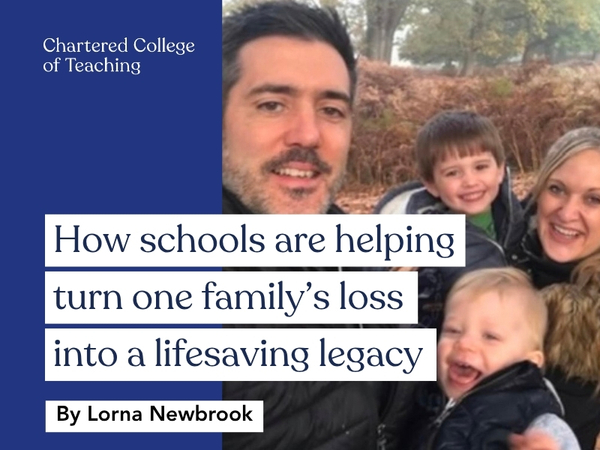
I have worked in education for 20 years. I have been a teacher, a senior leader and a deputy headteacher. I have spent much of my career telling young people that they have the power to make a difference I never imagined that one day I would be asking schools to help me make a difference in memory of my husband.
My husband, Mike, died in 2024, aged just 46, following a 16-month battle with cancer. Mike had spent 22 years serving others through the Royal Navy and the Police. He was 6ft 4in, larger than life, deeply loved, and the dad of our two boys, Joseph and Lucas.

During his illness, Mike needed more than 100 units of donated blood and blood products. Those donations did not cure his cancer. But they gave us something that, when you are facing the possibility of losing someone you love, becomes more valuable than anything else in the world. They gave us time. More birthdays. More conversations. More ordinary family days. More memories for our boys with their dad. Sixteen more months with Mike.
After he died, I kept thinking about those anonymous people who had rolled up their sleeves and donated blood without ever knowing who would receive it. They never knew Mike. They didn’t know me or our children. They didn’t know what their donation would mean to our family. But we knew, and I wanted to do something with that gratitude.
From grief came Pint for Mike
That was how Pint for Mike began. The idea was incredibly simple: encourage people to donate a pint of blood in Mike’s memory. I wanted people who had never donated before to book their first appointment. I wanted people who had donated in the past but had stopped to start again. And I wanted people to understand that behind every bag of donated blood is a real person and a real family desperately hoping for more time.
What started as a personal challenge has grown beyond anything I could have imagined. At the time of writing, the campaign has inspired more than 900 recorded blood donations in Mike’s memory, with the total continuing to rise. It has been featured on BBC Breakfast and national television and radio, and has been supported by people including Dan Walker and Dame Kelly Holmes. But some of the moments that mean the most to me have happened much closer to home – in schools and colleges. Because, perhaps inevitably after two decades working in education, I realised that education could become a hugely important part of Mike’s legacy.
Why schools?
There is a simple problem with blood donation: we need more people to do it. Only a small proportion of the eligible population regularly gives blood. Yet every day, donated blood is needed for people experiencing cancer, major surgery, childbirth complications, accidents and many other medical emergencies.
So I started thinking about our sixth-form students. We spend years preparing young people for adulthood. We teach them qualifications and employability skills. We talk about citizenship, responsibility, community and the contribution they can make to society. What if becoming a blood donor could be part of that conversation?
For many students, sixth form or college coincides with the point at which blood donation becomes something they can actually consider doing. It felt like an opportunity. So I created a free Pint for Mike assembly package for sixth forms and colleges, telling Mike’s story and explaining the difference blood donation can make.
Around 175 schools and colleges have now engaged with the campaign. Behind that number are thousands of young people hearing a message that I hope stays with them long after the assembly finishes.
The lesson I couldn’t have planned
As teachers, we plan learning all the time. We decide what we want students to know, understand and be able to do. But some of the most powerful learning goes beyond a specification. Pint for Mike asks young people to think about what it means to contribute to a community. It asks them to recognise that they have something within them that could, quite literally, help save another person’s life. And it makes something quite abstract – ‘giving blood’ – human.
Mike wasn’t a statistic. He was a husband. A dad. A police officer. A veteran. A colleague. A friend. He was the person our children wanted to come home. When students understand that, blood donation stops being something vaguely worthy that other people do. It becomes something they might choose to do themselves. That is what education can achieve at its very best: not simply giving young people knowledge, but helping them understand that their choices matter.
What Mike taught me about education
Losing Mike has changed almost everything about my life, including the way I think about my role as an educator. Our children were very young when their dad died. I have had to learn how to carry enormous grief while continuing to parent, work and somehow build a life around an absence that can never really be filled.
But I have also seen extraordinary kindness. I have seen colleagues step forward. I have seen schools embrace an idea simply because they could see the good it might do. I have seen strangers donate blood because they heard about a man called Mike and decided that his story mattered.
And I have been reminded that schools are about far more than examination results. They are communities. They shape values. They create habits that can last a lifetime.
Imagine if a young person hears Mike’s story at 17, books their first blood donation and then continues donating throughout adulthood. Imagine how many people that one student might help. Now multiply that across a year group. Then across 175 schools. Then across the whole education system. That is the possibility I see in Pint for Mike.
A pint – and a little more time
There is something beautifully simple about blood donation. You don’t need to run a marathon. You don’t need to raise thousands of pounds. You don’t need a huge social media following. You just need to give a little of yourself, it costs nothing. For the donor, it is a small part of their day, less than 10 minutes. For the person receiving it, it can mean everything.
I would give anything to have Mike back. Pint for Mike cannot change what happened to our family, and it was never intended to. What it can do is make sure that the time blood donors gave us is passed forward. Every new donor means another family may get more time with someone they love. And perhaps somewhere in one of those school assemblies is a teenager who will become a lifelong blood donor because they heard Mike’s story.
After 20 years in education, I cannot think of many lessons more important than that. Mike spent his life serving other people. Now, through hundreds of donors, thousands of students and a growing community of schools, he is still helping people.
One pint at a time.
Please go to pintformike.org to register your school to receive the free Pint for Mike assembly resources. Please consider going to blood.co.uk to book to donate and follow us @pintformike on Instagram. If you do donate, please let us know @pintformike so we can add you to our life-saving tally.