
For any trainee/student teacher, a core challenge of learning how to teach, is encountering, navigating and making sense of that which interrupts them—moments they notice and mark for reflection—amidst the complexity of the classroom. During an ITE programme, the classroom is an environment filled with rich yet fleeting moments, during which beliefs, preconceptions and even course content might be corroborated or challenged.
These moments frequently could mark the starting point for deep learning for a trainee/student teacher. With experience, teachers notice ever more and can build an instinctive toolkit of in-the-moment actions; but they remain hard to process in real time and rarely fit neatly into the overarching course structure and design.
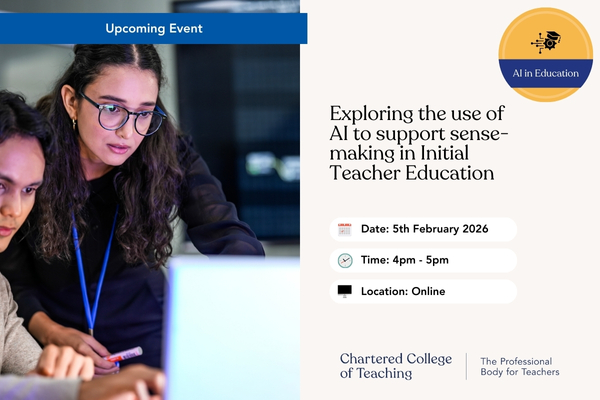
In this session, a panel of experts working across ITE and the use of AI to support teacher education will explore the importance of safe, supportive and non-judgemental spaces for disciplined, systematic reflection and “found” learning within initial teacher education programmes. It will focus on the role that AI technology could (and increasingly can) play in supporting key processes, such as:
- Helping capture these transient moments in transcriptions of dialog, videos of facial expressions etc;
- Analysing, synthesising and summarising to present nudges, prompts and reminders of moments to teachers after the fact;
- Providing on-demand support (and infinite patience!) to systematically explore and inquire;
- Supporting trainee/student teachers to consider what these moments mean for their future selves, their learning, and their students’ learning—re-integrating these insights back into whatever course structure is necessitated – if/when appropriate.
Participants will gain a deeper understanding of how some of the latest technological innovation can complement human sensitivity, enabling educators to notice, reflect upon, and act on these critical learning opportunities. This event is open to all, but is particularly relevant for those engaged in teacher education and professional development.


